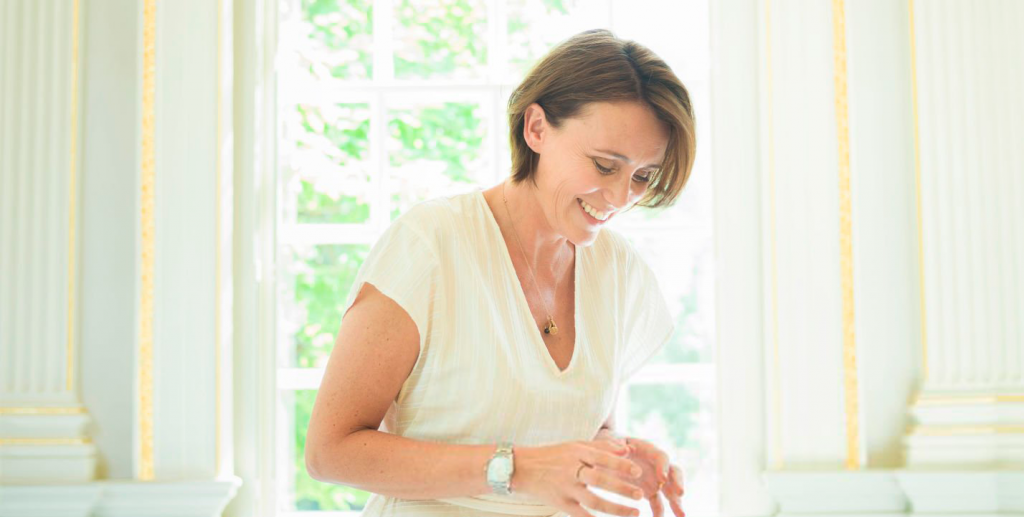
In a leafy corner of Twickenham, buying cake and coffee, Keeley Hawes is met with what is by now the usual question. “Are you that Durrells lady?” says the woman serving her. Yes, replies the actress, meaning that, yes, she plays Louisa, the fragrant matriarch of ITV’s hit Sunday-evening drama series The Durrells. “You look 20 years younger!” the woman adds. The actress, 42, laughs as she relays this moments later, though she’s clearly a little pained. “An apron can put 20 years on you, apparently.”
If Hawes is finding some downsides to being the “Durrells lady”, she can at least tell herself it will pass; since she first acted on screen aged nine, the roles have never failed to come in. From Tipping the Velvet to Spooks to Ashes to Ashes to The Missing to Line of Duty, she is, as she puts it in her cut-glass accent, always “boring everybody with something”. Next up is Bodyguard, another furious potboiler from the Line of Duty writer Jed Mercurio. What is she most recognised for?
“If I’m having a particularly ropy day, it’ll be Lindsay Denton,” she says, DI Denton being the distinctly scrubbed-down, frumpy, ambivalent copper who caused such a ruckus in Line of Duty. “But this morning I got recognised from Spooks! And that was 20 years ago. So,” she steels herself, “I must be having a good day.”
We meet at a cafe not far from the home Hawes shares with her husband, the actor Matthew Macfadyen, along with her three children — Myles, 18, from her first marriage, and Maggie, 13, and Ralph, 11, from this one. Hawes grew up in Marylebone, the daughter of a taxi driver, and is an alumna of Sylvia Young, but all that seems particularly distant now as we drink coffee overlooking a genteel park, unbecomingly scorched by this surprising summer. “When it’s not like straw, it’s really beautiful,” she explains.
She says she enjoyed her early years, but Marylebone was distinctly “grubby” back then. “I can’t imagine my children having a central London childhood.”
It’s actually in this park, at “some do”, that she had a fresh chat with Mercurio. He said he was working on something new, gave her a wink, then she heard nothing more about it. It turned out to be Bodyguard, where Hawes’s Julia Montague, a haughty and uncompromising home secretary, ends up in a twisty, terrifying rapport with her new security handler, David Budd (Game of Thrones’ Richard Madden).
“I have no idea if Jed had me in mind when he was writing it,” Hawes says, “but they definitely knew then that there would be a central role for somebody like me.” And what is “like you”, I ask. “Oh, God knows. This dull woman!” she laughs. Hawes, if delicate in most respects, has a heavy line in self-deprecation. I push her further. Is it those angry, heavy eyelids? She smiles. “Yeah, that’s what it is.”
She’s good at looking sullen. “And I’m not sullen, am I?” she says, mock-hurt. I reroute. How about “contained anger”? “Yeah. I enjoy contained anger.”
That is no scoop. Hawes is never better than when sighing, huffing and puffing her way through some intrigue — no more so than in Line of Duty, where she got to let loose, in her own steely way. Is it crude to call it a game-changer?
“It’s interesting,” she says. “You don’t wear mascara, and people say it’s a game-changer. It’s a bit sad, isn’t it?” She pauses — then adds that she “relished” the opportunity to “go down that road, physically. Quite apart from the fact that being in a make-up chair for an hour and a half every day is as boring as hell.”
This is an old refrain where actresses are concerned, just as it’s a cliché that as soon as they “frump up”, they bag the plaudits. But there was still something particularly surprising about Hawes doing it, as she always seemed so still and soignée. Even today she is polite, drily witty, but nothing falls out of place. “I was asked to do something a few years ago, and it was going to involve fake teeth and so on. And it was as if the people involved didn’t believe that, when the day came, I would actually do it. People were calling and saying, ‘Are you sure?’
And then the whole thing didn’t happen anyway. But it was really interesting that their fear was that I would actually get there and say, ‘Oh, you know what…?’”
Bodyguard does not involve any fake teeth. As Montague, Hawes gets to look stylish and efficient, in a Westminster kind of way. But Julia is, she concedes, a “cousin” to Lindsay Denton. “She’s not especially likeable, she’s quite hawkish.” At the time of filming, we had a female home secretary, too, but Hawes insists this isn’t an impersonation of Amber Rudd. “We didn’t even talk about Amber Rudd. The person who did keep coming up was Margaret Thatcher, which I thought was right and good. It’s not her in any way, but it’s that ambition, that thing about doing it at any cost, and not doing things just to be popular.”
The conversation flits over Rudd, Thatcher, Theresa May. What does she think of the argument that women in power always have to assert “male” characteristics? “I don’t know,” she says. “I suppose Julia is male, in a way. But maybe it’s that thing of a woman being strong and being called bossy, and a man being strong and being called strong. That’s the difference.
“I hate that description, though,” she tuts, “that all the female characters we have now have to be ‘strong’. It would be a boring world if we were all just really strong, and strident — it’s not true. Nobody I know is just a ‘strong woman’. Julia’s got fragility as well, but her public persona is strength. It has to be. Theresa May has to be. The minute you see a chink, you get ripped apart.”
Hawes herself has very few chinks — she remains a consummate professional. She has the poise of one of those precocious types who does everything early — work, marriage, kids — and doesn’t seem to have gone off the rails. Like a lot else in her life, she doesn’t present any great motivation behind having her children at ages that, for aspiring actresses, could seem pretty early. “It just didn’t occur to me that I wouldn’t have children, and that I wouldn’t have children quite young.” And, suddenly, here she is with an 18- year-old. And also, potentially, time for more? “No, no! I’m done and dusted.” Some of her friends are having kids now, and she can only respect it. “All I can think about is going to bed!”
She is now an executive producer of The Durrells, which will film its fourth series this autumn in Corfu. The show, based on Gerald Durrell’s rather romantic memoirs (which she loved as a child), is a joy to make, she says. “And it’s a lovely story to tell, because it’s true!” Now then, Keeley, come on. It’s kind of true.
“It’s kind of true,” she concedes. “It’s based in truth. Its heart is in truth!” She laughs. How much of it is a fantasy? “Umm, we don’t need to go there.” Louisa, for instance, was a bit of a raging alcoholic, wasn’t she? “I think she was a bit of an alcoholic, which we do touch on. We have seen her enjoying a drink a little bit too much. But it is a Sunday-night, 8pm family show.”
As a producer, she gets to draw on her 30-odd years of filming experience, and “stick her oar in” with the scripts. So is that being bossy? “It is being bossy,” she says. “I really like it. And I don’t mind the word ‘bossy’, either. I think, having three children, someone has to be the boss, and it may as well be me.” She is, she says, “so, so organised” — even her socks are organised.
Does she do good cop, bad cop at home with Macfadyen? “We share those roles,” she insists, but a second later: “No, I’m a whip-cracker. I just think, if you’re going to do something, do it properly.”
Where does that come from? “I don’t think it’s a family trait. I actually don’t know.” Hawes was one of four children. I ask her where she came in the order. “I’m at the bottom. So there you go, maybe there’s your answer.”
Hawes has been working three jobs this summer, so what she mostly yearns for next is a break.
However, she still has ambitions. “I’d quite like to do a play with my husband, because I think he’s a brilliant stage actor,” she says. Somehow this surprises me — would you really? “I absolutely would, yes.” Does he know this? “Yes, he does. There I go, cracking my whip!” More seriously, I’d have thought any sane acting couple would try to avoid working together. “No. He’s the world’s worst at corpsing. He’s such fun to work with. And you’d never imagine that — I never did before I worked with him. [They met doing Spooks.] He seems very serious. And he’s the world’s worst.”
It’s a really surprising idea, though, because treading the boards has had mixed results for her. A few years ago, Hawes made a rare foray into the West End, starring in the comedy Barking in Essex. Unusually, she chose not to finish the run, apparently because of blazing rows with her co-star Sheila Hancock. The details are scarce, but none of it is really denied.
“That was tricky,” she says, when I bring it up. Did it singe you, or would you go back? “Never say never.” Has time been a healer? “Time is always a healer. And if it isn’t, it should be. People should get over themselves.” Is there anything you’d do differently, now, in that particular situation? She looks me dead in the eye, and smiles. “No!”
Bodyguard is on BBC1 later this month