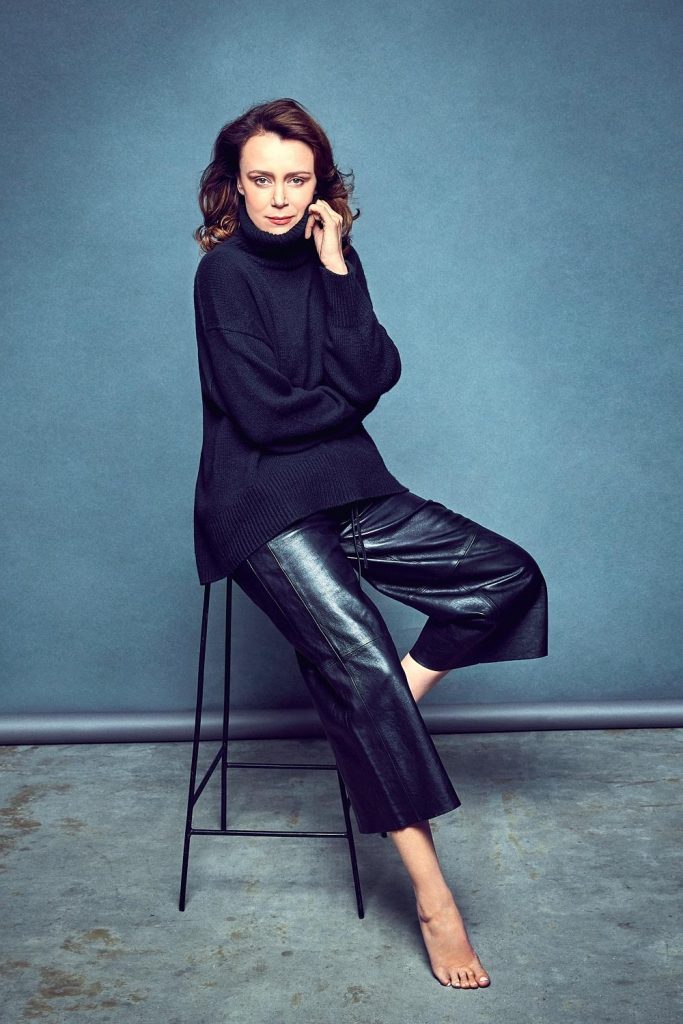
Five years ago she was struggling to find work. Now, at 43, Keeley Hawes – who made headlines as the home secretary in Bodyguard – is TV gold.
Keeley Hawes appears somewhat weary. Her two youngest children have a bug: one is lying at home on the sofa; she’s not sure the other will make it through the school day. “Phlegm everywhere,” she says with an expressive roll of her almond-shaped eyes, as she enters the Richmond café where we’re meeting. “I think I might be coming down with it. After this, I have to go to Boots. I’ve a long shopping list.”
Hawes’ star just seems to rise and rise and rise. When I last met her, in 2010, she was 34 and – thanks to TV shows such as Spooks and Ashes to Ashes – one of the nation’s favourite television actresses.
Today, however, such successes have been eclipsed by her subsequent roles in Line of Duty, where she played the delightfully wretched cop Lindsay Denton, Sunday night favourite The Durrells, where she’s the cosy matriarch, Mrs Durrell, and – most notably – last summer’s Bodyguard, where she was the home secretary, Julia Montague. The show was the most watched iPlayer drama of the year, while its finale audience of 17.1 million made it the most popular episode of any drama since current records began in 2002.
At 43, an age at which – not long ago – actresses resigned themselves to dreary mother-of-the-bride roles, Hawes is television gold (she’s also recently appeared in the BBC’s Mrs Wilson and Channel 4’s Traitors). Hawes herself didn’t see it coming – around the time we last met, she was quoted as saying, “I don’t expect to carry on for ever. When you get into your forties, the roles do tend to drop off and I’ve seen it happening to friends of mine.”
“Hah!” is Hawes’ only comment when I remind her of this. “It’s such an exciting time,” she continues, though she’s not smiling. “Historically, you are not supposed to be getting to my age and having the time of your life, but the parts are getting much more interesting. Until a couple of years ago I felt apologetic for being as busy as I am, which is very odd. So I have had to have a word with myself.”
She’s no longer apologetic? “I’m no longer apologetic. It doesn’t all end in your forties. There are lots of us [40-plus actresses] now and great parts are being written for us. Times are changing.”
Certainly Hawes has changed since our last encounter. Then she was warm and funny – “radiating joie de vivre”, I wrote – as she chatted away about life with her husband, actor Matthew Macfadyen and her three children in pukka Strawberry Hill, nearby.
Today, in contrast, while she’s perfectly pleasant, she’s far more remote. The raucous laughs that punctuated our last conversation still come but infrequently; her beautiful, chiselled features, then so animated, are now far more solemn. I’ve already been warned by her team (there didn’t used to be a team) that she doesn’t want to “talk about Matthew” and although family life comes up in passing, she makes it clear we are here to discuss work only.
My take is that having only just started truly to rate herself as an actor, Hawes has decided that homey chitchat devalues her. Three babies gobbled up a chunk of her acting years, but now she’s free of such ties. There’s also the fact that her children are older and may not want their mum gabbing about them. Then also, as mentioned, she’s just feeling a bit rubbish.
Lightly tanned and apparently make-up free in a black roll-neck jumper, black trousers and gold hoop earrings, Hawes’ new steeliness also seems to be a retort to her natural inclination to be a people-pleaser. In the past, she’s spoken of having suffered from depression as a teenager (“I don’t really want to go into that,” she sighs wearily when I mention this) and being a worrier. “Worrier is probably the wrong word,” she says. “Worrying’s probably quite healthy so long as it’s not something that overtakes you. It means that you care. In terms of acting, I’m conscious that I want to be as good as I can be.”
This year Hawes will be ubiquitous. As well as the upcoming final season of The Durrells, she’s in Stephen Poliakoff’s Summer of Rockets, a six-part Cold War drama for BBC Two, and the film Misbehaviour, co-starring Keira Knightley, Gugu Mbatha-Raw and Rhys Ifans, about the 1970 Miss World contest being disrupted by feminist activists. She plays the beauty contest Svengali Julia Morley. “You think, ‘Why hasn’t this story been told before? It’s incredible.’ But I guess now is the right time for it.”
Yet, despite appearances, she’s not working constantly: in fact, when Bodyguard creator Jed Mercurio (also the man behind Line of Duty) cast her, she’d been out of work for five months and – according to reports – was considering jacking it all in.
“You only need to go two days without work to start thinking you’ll never work again. But I was never thinking about changing career,” she says. “Five months out of work is sort of great because you spend time with family, but it’s not great because you are at the mercy of other people – it’s open-ended. Now, I’m finally at a point where I’m learning to try to enjoy the time off I have – it takes a while and it takes confidence.”
No one, she says, could have predicted Bodyguard’s success. “If I knew why it worked I’d be making it happen again,” Hawes says with a rare gurgle of laughter. “It was a little bit of everything: the timing, the writing. It just fired people’s imaginations; maybe they were sick of talking about Brexit and wanted something else to talk about. When we were making it we were quietly confident, but you often feel that confidence and things don’t work out. Lots of things went wrong during the shoot. It wasn’t the easiest; it was hugely ambitious. We lost Waterloo – we were meant to be filming the [opening, heart-stopping] train sequence there, and suddenly it wasn’t available, so there was disarray. It was just a case of getting through it and then I left and Richard [Madden, the eponymous bodyguard] carried on.”
Hawes left because – spoiler alert to the dozen people left who haven’t watched the show, which is now on Netflix – at the end of episode three Montague was killed by a bomb. The internet, however, refused to accept this: conspiracy theories abounded about how a body had never been shown, along with predictions that she would resurface, pregnant with Madden’s baby, in series two. All of which was fanned by Hawes reappearing as Montague for a recent Comic Relief spoof.
“It’s the most flattering thing ever, that people won’t hear I’m dead, because they could have been quite relieved I’m gone,” Hawes says, sipping a cappuccino. “So many people come up to me and go, ‘I lost a bet because of you. I said you’d come back and you didn’t.’ ”
So, Montague really is dead? “Yes!” What about Denton, who was arrested at the end of Line of Duty’s series two only to make a surprise reappearance in series three? “Well, Jed had me shot in the head on screen, so yes, too.” But she might be resurrected like Bobby Ewing in Dallas? “No! Lindsay is dead.”
Hawes’ partnership with Mercurio (he lives close to her in Teddington, but she says they don’t hang out socially) has been a gamechanger. Before Denton, most of the women she played were good eggs – prim spy Zoe in Spooks, doormat-y Lizzie Hexam in Our Mutual Friend, charming Lady Agnes in the forgettable BBC remake of Upstairs Downstairs.
“Denton was amazing for me,” she’s said previously. “It was so unglamorous and so dowdy – and it got dark, and I just hadn’t had the opportunity to do that before.” Similarly, Montague was Machiavellian and frequently harsh in manner.
“Jed is so clever. His casting is genuinely gender-blind. It could just as easily have been a male home secretary and a female bodyguard,” Hawes asserts. Former home secretary Amber Rudd recently approached Hawes in the Wolseley restaurant “and was very supportive of my interpretation”. Not, she adds, that Julia was “based on Rudd”. Or Theresa May? “Definitely not Theresa May!”
Nor, Hawes continues, does she think Mercurio “even thought” about the fact Hawes was 11 years older than her bodyguard lover (Madden is 32). “The age gap was not ever mentioned. It’s not in the script, not discussed by anybody.” Some Americans were confused by Madden’s Scottish accent, convinced he was calling his boss not “Ma’am” but “Mum”. “That would have been too weird,” says Hawes with a weak smile.
I wonder if playing such parts has contributed to Hawes’ new, professional demeanour. She’s also been clearly influenced by the #MeToo movement, coinciding with a wave of actresses demanding equal pay.
“I’ve only just asked to be paid the same to do exactly the same work as someone else. In the past it was always a case of take it, no questions asked, because if you don’t someone else will take it,” she says. “You need a big profile to be able to stand up for yourself. It took people like Jennifer Lawrence [the Hunger Games star who wrote an essay for Lena Dunham’s Lenny Letter questioning why she earned less than her male co-stars] saying it to move things forward. It made her unpopular at the time but it’s started a hugely powerful movement. Generally, the statistics for women’s pay are still horrific compared with men’s, but it’s all moving in the right direction.”
Hawes discusses the gender pay gap with her daughter, Maggie, 14, and her sons Ralph, 12, and Myles, 18 (with her former husband, cartoonist Spencer McCallum). “It’s part of that generation’s culture to talk about feminism, the environment – the big issues of our lives. They are politicised in a way that I certainly wasn’t. My 18-year-old is incredibly upset by Brexit; he was 16 when it happened and there was that frustration that he couldn’t vote.”
We discuss the monthly Friday school strikes, with children walking out of class to protest against climate change. “I wouldn’t stop my children doing that. It’s a good thing. Hopefully that generation will be the one to change things.”
Acting wasn’t in Hawes’ background: the youngest child of a black-cab driver (one of her two brothers still is) and a housewife, she grew up behind Marylebone station in central London. At nine, she won a scholarship to the Sylvia Young Theatre School, which had opened right across the road from their three-bedroom council flat (her cut-glass accent is the result of school elocution lessons).
Having learnt her trade alongside classmates that included Emma “Baby Spice” Bunton and Denise Van Outen, she left school at 16 with a handful of BBC credits to her name, initially modelling and appearing in various Britpop music videos. At 20, she had her break when she was cast in Dennis Potter’s Karaoke. Spooks was the show that made her a household name. On that show she also, in 2002, met Macfadyen, who played a fellow intelligence officer. The timing wasn’t great – she had married McCallum just eight weeks previously.
In the past, Hawes has been happy to embellish with details about how, “Matthew just came straight out with it and said, ‘I love you,’ in the rain one day. I thought, ‘Oh dear, here we go.’ ” She talked about how the couple only got together after she left McCallum, how for years she was plagued with guilt about her betrayal (today everyone is best friends), how she and Macfadyen married when she was five months pregnant with Maggie and moved into a crumbling Victorian pile they’ve lovingly restored.
Again, last time we met she was full of juicy, frankly envy-inducing domestic details about how Matthew (the cook in the relationship) had just installed a fancy range cooker, their chickens, their shared passion for The World of Interiors magazine, their manny and their fluffy white coton de Tulear dog. Matthew, apparently, had bought her a Morris Minor and liked to select garments for her at Margaret Howell. She was gutted because she’d had to turn down a dream role in an adaptation of Sarah Waters’ The Night Watch because a family holiday was booked in Mauritius, but “the family stuff is too important. Something has to give.”
This time, there’s none of that – the most I glean about her home life is that Hawes loves an early night. “If I’m not in bed by 9.30pm I panic, but then I’m often up at 5am to be on set.”
Then, she’d been frank about the difficulties of combining two high-profile careers with family life. “It’s just quite difficult,” she said. “Every job Matthew gets seems to be away for some reason, and it’s really hard. Really hard. We say we’ll make it work and most of the time we do. We try to do it so one of us is always there for the children, so I’ll do a job and then he’ll do a job, without too many crossover periods. But it’s lonely. Matthew’s the cook, so when he was away I got quite thin. I’d just stand at the fridge and eat a bit of cheese. Now he’s back you can hear the pans coming out every night again.”
Since that time, their lives must have become even more complicated: she’s spent long chunks of time in Corfu filming The Durrells, while he’s currently in New York making the second series of Succession, the Sky Atlantic drama about a billionaire family’s multimedia empire. But when I ask how they manage it, Hawes’ expression turns frosty. “It’s not even something we think about; we’ve been married for 15 years so we’re finely tuned. It just works,” she says. “Anyway, we do spend a lot of time together; we’re not always away.”
She and Macfadyen, 44, don’t often watch each other’s shows but she did enjoy Succession, in which he is the star turn playing Tom Wambsgans, the ludicrous yet borderline psychotic fiancé of the patriarch mogul’s daughter, who sums up his own character with the line, “I may look funny, but I’m a terrible, terrible prick.”
“It’s brilliant, he’s just so bizarre,” Hawes exclaims. “I’m enjoying it so much. Matthew’s very clever.”
The Durrells, she adds, “is also a hit in our house”, not least because the family’s enjoyed several holidays in Corfu while she’s been filming. “We’re very popular with the tourist board – the show came along at what was not a good time for Greece.” Over the past four years, she’s seen her four on-screen children grow up. “It’s been so magical seeing them at the start of their careers.” Are her children jealous of their television rivals? “No, they just think they’re supercool.”
It’s “bittersweet”, she says, that the forthcoming series is also the last. “I am sad it’s over but it feels right – the children’s careers are all exploding and everyone is doing different things.” Still, they’re going out on a high. “Everything’s drawn big for the finale. We’ve saved up and handpicked all the best stories and thrown everything in. I’m so proud.”
The pride is not just for the acting, but because she executive-produced the series, a first for her. “It was the perfect show to start doing it on because I knew it so well,” she says. “I’ve been doing what I do for a long time and you get to the point where you are on a set and people are much younger than you and starting out and you think, ‘I have something else to bring.’ Not every actor feels like that, but more and more I feel I have the experience.”
It’s an odd moment, I say, when – having started out the baby in a profession – you realise suddenly you’re one of the oldest. “I know. I still feel like I’m one of the youngest but people are looking at you for advice. It’s not bad – it’s a great feeling, though inside I still think I’m 18 years old.”
Again, I’m struck by the fact that Hawes may still consider herself a teenager, but her stance is completely no-nonsense adult. She’s taken to using Twitter to correct inaccuracies written about her. When last year a tabloid claimed she’d lost weight for Bodyguard through an “alkaline diet and an exercise regime”, she tweeted back: “Um, no, I didn’t. #whowritesthisshite? #whatthef***isan alkalinediet?” More than 7,000 people retweeted it and 44,000 liked it.
“Usually, I think, ‘Let it go. You’ll have forgotten about it by tomorrow.’ But I couldn’t let it go; it was so irresponsible.” In terms of the messages it sent to women about dieting? “Yes. It was a total fabrication. It wasn’t the end of the world but it was good to say, ‘No, that’s wrong.’ ”
She doesn’t have Instagram, she adds. (“Do you think I should? My son and I do like memes and it would be good for that.”) Plenty of fake accounts run under her name. Does she find that strange? “I couldn’t care less,” Hawes says. “You have to let things go. You can’t control every aspect of your life.”
Her PR arrives to tell us time’s up. Hawes stands up, beams at a baby at the table next door (“I love other people’s babies”) and makes small talk as she flicks at her hair, which is in her eyes. “I’m still growing out the Seventies fringe from Misbehaviour. It’s so annoying.”
When she’s off duty, like this, it’s like sunshine coming out from behind the clouds. Still, I respect Hawes for adopting this new, steely persona. As she says, “I have been doing this for ever and I am in a very positive place.”
The Durrells returns to ITV at 8pm tomorrow. Summer of Rockets is broadcast this summer on BBC Two