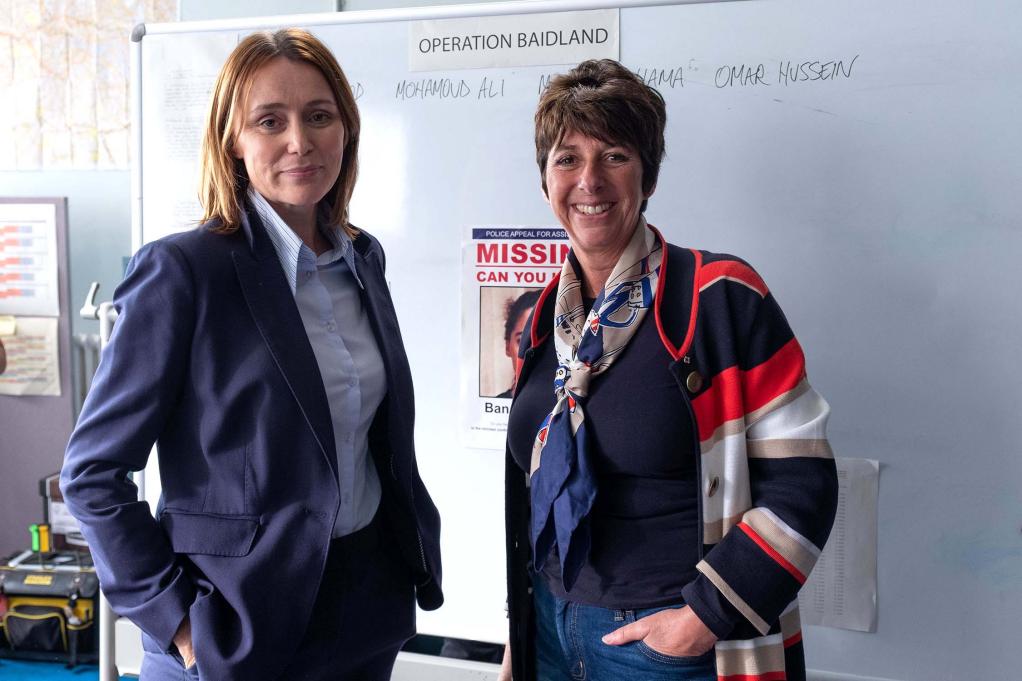
In April 2006, the body of 20-year-old Londoner Banaz Mahmod was discovered buried in the garden of a house in Handsworth, a suburb of Birmingham.
It was later revealed that members of Banaz’s own family (including her father and her uncle) were complicit in her shocking murder after she left an abusive forced marriage and started a new relationship of her choosing.
Mahmod’s death, which is the subject of powerful new ITV drama Honour, starring Keeley Hawes, sparked a debate about the practice of so-called “honour killings” and how she was let down by the police, who failed to take previous death threats she reported seriously.
Banaz’s appalling death was investigated by Detective Chief Inspector Caroline Goode, played here by Keeley Hawes. Goode’s determined drive to bring about justice for Banaz after authorities failed her is at the centre of this tense, poignant and uncompromising two-part series, which is written by Gwyneth Hughes (Silent Witness).
“It was a very emotional job for everyone working on this drama,” says Hawes, whose is also executive producer. “Inevitably, all of us took the job home with us at night. Not a moment went by when we weren’t talking or thinking about Banaz. I still find it emotional today. The image of Banaz will always move me.”
Before the first episode of Honour airs on ITV, find out more about the show from Keeley Hawes.
VM: Hi, Keeley. How much did you know about this story before you took on the role of DCI Caroline Goode?
KH: When I was sent the script I felt ashamed I knew so little about it. I read the scripts and went through every emotion. I thought I could really learn about this subject.
VM: Was there anything in particular that really drew you to the drama?
KH: One of the reasons I chose to do this was because it was shining a light on so-called honour… I hate to use that word. It’s rape, it’s murder, it’s abuse. We can use our work do to that and in this case it’s incredibly worthwhile.
VM: How did you become executive producer?
KH: I was at point when I wanted to take on producing and go behind the camera – and I really enjoyed that aspect of it. It was a very tentative first step into producing, but this couldn’t be more important as a story.
VM: What can you tell us about your character, DCI Caroline Goode?
KH: She’s just an extraordinary woman. This is a story about two extraordinary women. I read the script and then I watched Deeyah Khan’s documentary Banaz: A Love Story, so I was able to see this woman in action and talking about the experience I’d just read about.
VM: What is it that you admire about her?
KH: Her tenacity, determination and love for Banaz was unlike any other story I’d ever come across.
VM: Did you get to meet her?
KH: I did meet her. She came to the set very early on and we had a cup of tea. It’s always odd meeting someone you’re going to play. It’s a very strange thing. We had some artistic licence because unless you know Caroline Goode, you don’t know Caroline Goode.
VM: What did you ask her?
KH: I asked her if it was as emotional as the drama and she said: “Yes, of course.” I felt very lucky to be able to talk to her. She’s a real force. We had to tone her down as well. She wore heels the whole time, but we thought that would be too distracting, so we created our own version of Caroline.
VM: Did you feel a big responsibility in terms of telling this story truthfully?
KH: We were all so mindful that we were dealing with real people. Probably more mindful than anything I’ve worked on. The responsibility is huge, I felt it every day. I haven’t taken it lightly. You want to do the right thing by everyone involved.
VM: This couldn’t have been easy to film. How tough was it on set?
KH: It was pretty relentless. You have to go home and decompress, have dinner with your children. And that’s after filming in a morgue all day. It has an effect.
VM: You’ve worked with director Richard Laxton before on the drama Mrs. Wilson. What did he bring to the process this time around?
KH: What really helped was having Richard as our director, our constant on set. He has wonderful sensitivity and an incredible ability to keep things light. He has a light touch on set, while taking every moment seriously.
VM: Finally, what do you hope this drama achieves when it airs?
KH: If one girl, or woman, doesn’t have to go through what Banaz had to go through, then the show is a success as far as I’m concerned. It’s been a real education for me.