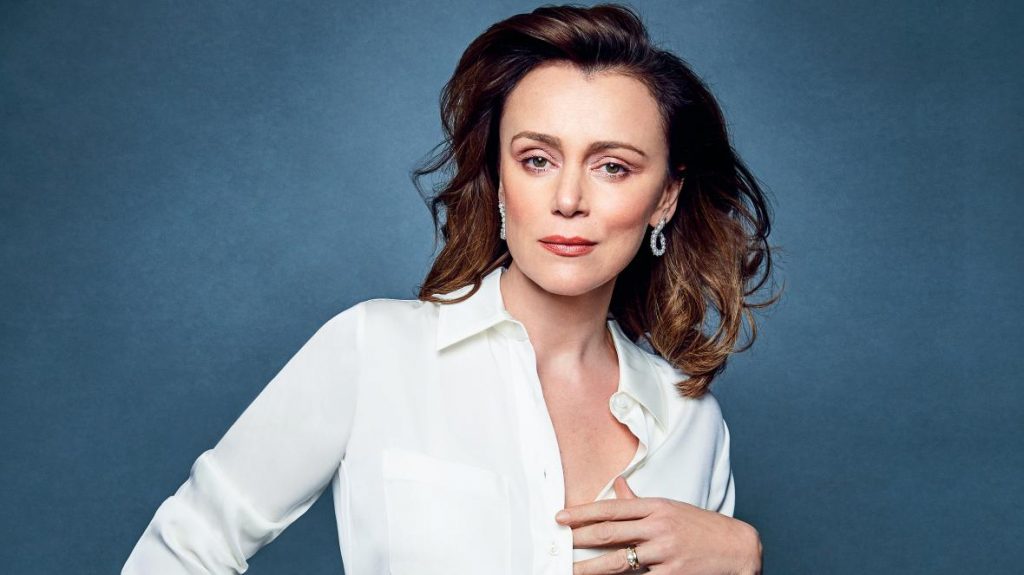
Sadly this bleak midwinter it does not fall to Keeley Hawes to take our minds off the Grim Reaper — but then how was British television’s favourite actress to know that a pandemic would bring universal resonance to the three separate dramas she was about to star in? Although Finding Alice, It’s a Sin and To Olivia are hugely different in tone from one another, they are all much possessed by death. Each time, however, Hawes attacks this meatiest of subjects with something like relish. At one point, as we discuss the most distressing of the productions, Russell T Davies’s Eighties Aids serial, she describes working on It’s a Sin as “an absolute joy”. Watch and you will understand what she means.
Death is not a new entry in 44-year-old Hawes’s CV. Five years ago as Detective Inspector Lindsay Denton in Jed Mercurio’s Line of Duty she was murdered by one of the show’s bent coppers. In Mercurio’s Bodyguard her character, home secretary Julia Montague, was blown up. Last year’s Honour, in which she played a real police officer, was a dramatisation of the hunt for the murderers of a young woman killed by her family. Even Louisa in ITV’s contrastingly life-enhancing The Durrells was a widow.
Now playing the title role in ITV’s Finding Alice, Hawes is widowed again. Co-created by her, The Durrells’s writer Simon Nye and its director Roger Goldby, the six-parter is as much comedy as drama. In episode one Alice’s husband Harry dies, leaving her to work out the secret intricacies of his life. As her life unravels she is forced to find out who she truly is — an irreverent process that requires her to deal with her childish parents, played by the dream team of Joanna Lumley and Nigel Havers.
“It’s very nuanced and quite a lot more humour came out in the shooting of it than was even there in the scripts,” Hawes says by Zoom from her family home in southwest London. “I mean, Joanna Lumley has funny bones. Nigel Havers has funny bones. The tone of the show is quite unusual.”
Yet the grief and isolation that Alice feels have become very common in the past year, I say. She agrees and mentions a family member — she asks me not to say which — who died after a “short and cruel” illness a little over a year ago. Since then, so many others have suffered similarly unexpected tragedies.
“Awful, just appalling. I hope in some ways Alice’s reaction to her grief will not be shared by lots of people. Some people will be able to relate. Some people will be shocked. But grief is unique — isn’t it? — to each one of us.”
With Finding Alice half-completed, Covid halted filming in March. When the cast resumed six months later they rehearsed in masks briefly whipped off for takes. For Hawes’s newish production company, Buddy Club, it was a “hell of a learning curve” (the lead producer was happily the long-established Red): “Covid was just a grenade thrown in there. We had four cast members who were 70 plus. It was very, very tricky.”
Alice quickly turns out to be more practical than she thought. She digs her own husband’s grave (Hawes learnt to operate the digger). At the start of her bereavement, however, she is lost, specifically in the smart home Harry has created in which she does not even know how to open the curtains, let alone their online bank account. Hawes’s opening line is “Where’s the f***ing fridge, Harry?”
With her husband of 16 years, Matthew Macfadyen, filming Succession in America, Hawes has become used to breaching the divisions of their domestic labour. The pandemic meant they spent much more of 2020 together — eight months — than had been planned, but Macfadyen returned to New York in the autumn. Without him Hawes is still not on great terms with the computer, although she is helped by her children: her grown-up son from her brief first marriage and a teenage boy and girl with Macfadyen.
“Regardless of male/female, there is a who-does-what within a relationship. Certain things fall to each partner. Awful as it is, all of the scenes with Alice at the bank and her being unable to access their accounts, not being able to pay any bills, you know, it’s factual. Unfortunately that is the way that things are [in marriages] and that has got to change.”
By rights It’s a Sin should be a much more solemn affair and at times it is. Yet although Channel 4’s five-part serial charts the largely tragic stories of three gay 18-year-olds who land in London in 1981, Davies has written scripts that not merely celebrate the hedonistic energy of the protagonists’ sexual liberation, but find humour in society’s reaction to the “gay plague” and in the boys’ reaction to its reaction.
She plays Valerie, the narrow-minded, blinkered mother of Ritchie (played by the singer Olly Alexander) who escapes the Isle of Wight to pursue both a career as an actor and his sex life. Valerie ignores every flag frantically waved in the direction of who he is. The result is that she denies him the comfort he needs. I ask how she went about playing such a terrible woman.
“Well, firstly I think, you know, as an actor you have to find empathy with whoever you’re playing, whoever it is. I had to, and we have to, understand that Valerie is a product of her generation and her upbringing and that is why she is as she is. She doesn’t think she’s an awful person. Lots of people don’t think they’re awful people. They can totally justify their feelings and so does she. She thinks she’s right until — not giving too much away — that last scene, which is just utterly heartbreaking.
“The last thing Valerie says is, ‘I didn’t know.’ She didn’t know because she wasn’t informed. She didn’t have the facts. She didn’t want to know. And by the time she realises she doesn’t know, it’s too late, too late for everything. That’s what is so deeply heartbreaking about her. I mean, it is the only time actually I’ve ever seen it: a [film] crew visibly upset by scenes. That doesn’t happen. It really moved everyone.”
I ask if she is as amazed as I am that the Aids epidemic, which has so far killed more than 30 million, is so little recalled in relation to the Covid crisis (which has so far claimed more than 1.85 million lives). “It was huge at the time. You’re right. Now people, at this time, they’re saying, ‘We’ve never known anything like this in our lifetimes.’ ”
Davies, without elaborating on his experiences even to the cast, says the series is partly autobiographical. Perhaps as a result, although he heightens scenes beyond naturalism, the cumulative effect is real and specific.
“I can watch it objectively because I’m in it so little actually up to the final episode,” Hawes says. “I think it’s just a wonderful piece of work. I think it’s one of his greatest so far. And it was an absolute joy, weirdly, because of the subject matter.”
Does she think there are still Valeries around, 40 years on? “I think there probably still are Valeries. There are people who don’t believe that Covid is real.”
Or believe in vaccination, I throw in, for at the end of the third of her forthcoming dramas, To Olivia, a caption comes up about the importance of immunisation. The feature film, which will be shown on Sky Cinema, dramatises the aftermath of the death of Roald Dahl’s first child, Olivia, aged seven when she was killed by encephalitis brought on by measles. Dahl became an advocate for vaccination and wrote the still well-read 1986 pamphlet Measles: a Dangerous Illness 24 years after her death.
Hawes plays the children’s author’s first wife, the Hollywood star Patricia Neal, who must survive the death of their daughter while also repairing her husband (played by Hugh Bonneville). Dahl’s despair is not relieved when he seeks spiritual solace from his old headmaster, later the archbishop of Canterbury, Geoffrey Fisher. A remarkably unsympathetic and childishly dogmatic cleric in this representation, he is played by Geoffrey Palmer in his final role before his death last year a 93.
“He came in and basically wiped the floor with everybody. He was word perfect and he kept us all amused between every single take. We sat and had lunch together and I’m so grateful for that. It was just a wonderful memory,” Hawes says.
In contrast, during her recent bereavement she says the family was much helped by a supportive vicar. Hawes, however, has no faith herself. “I’m quite envious actually of people who do. I’ve thought a great deal about it, particularly in I — you know, the idea of losing a child. I can’t imagine, obviously. But if people are helped and comforted by their faith then . . . I’m sure the older you get, there is comfort in faith.”
Dahl’s mental ill-health in the film contrasts with Neal’s practical response, which is to concentrate on her other children’s wellbeing and accept an offer to co-star with Paul Newman in the 1963 movie Hud for which she won an Oscar. Hawes, who has spoken about having suffered periods of depression since her teens, uses a similar medicine.
“It sort of sounds like a flippant thing to say, ‘It’s easier if you’re busy. Distract yourself.’ I think that’s probably not quite what I mean. It doesn’t deal with the problem, being busy, but if you are like Patricia, you have to carry on and it does get better. It helps me to keep busy and to keep my mind busy.
“It’s nothing to be ashamed of, you know. I was ashamed of it for a long time. I was really embarrassed and now, looking back, it was only sort of ten years ago or something I think that I spoke out, maybe not even that. It’s not that long ago and people are talking about it more now and I think that can only be a really good thing.
“Particularly now. The loneliness! People are spending an awful amount of time on their own and I’m not sure how we’re going to come out of this. I read the other day there is a huge cash injection coming from the government to help. I hope so because it will be a disaster coming out of this. The waiting lists for people to speak to psychiatrists and get those appointments are so long that it’s just not acceptable.”
As our chat ends, we consider again the preoccupying themes of the shows we are about to see her in. She rightly points out none is without humour and each piece about more than grief. That said, it may be time for another change of tone.
“I’d really like to be in a Christmas film,” she says. “Anything. Anybody wants to offer me a Christmas film, I’m in.”