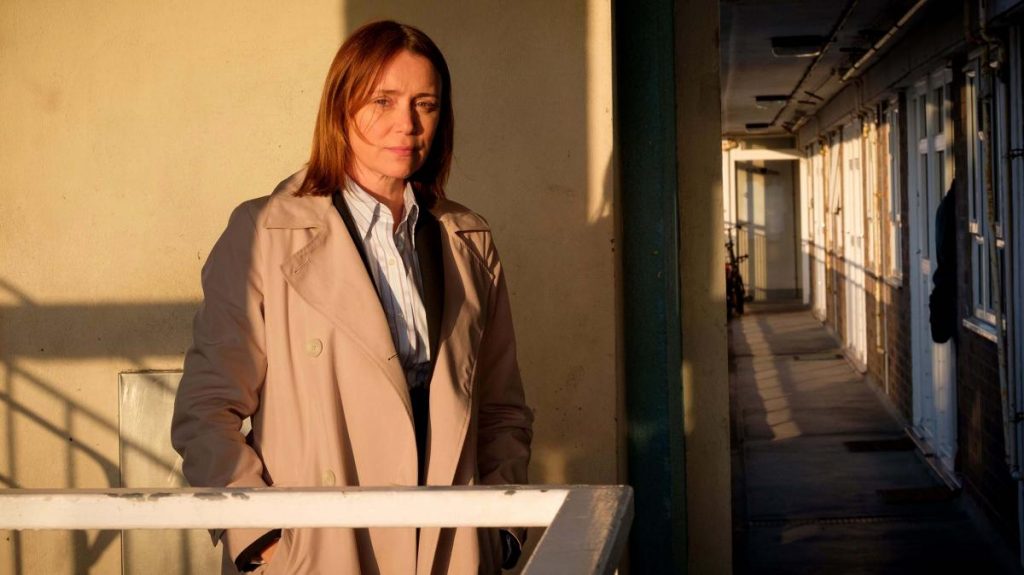
Playing the real-life detective investigating the murder of a young woman was a draining emotional journey, says the Durrells and Bodyguard actress
Keeley Hawes has been fielding calls. One of our foremost television actors, she happens to be married to another, Matthew Macfadyen, and in the age of social distancing, when most cast members can’t come within spitting distance of each other, the Hawes-Macfadyen duo are the ultimate catch. “We are definitely on that couples’ list,” Hawes says with a chuckle. “The lockdown movie couples list. It’s inevitable. Even I was like, ‘Right, we’re together, what can we do?’ I would love to work with Matthew. The only problem is he’s terrible at giggling. He’s a corpser. And so am I.”
There it is, then; hope that it might happen. Hawes is, after all, yearning for a light-hearted part. For the past year or so every role she’s taken — and there are many — has been one of suffering.
“It’s been exhausting,” Hawes says, sighing. Although you wouldn’t know it: she seems upbeat, constantly interrupting herself by laughing. Even the usual irritations of video conferencing don’t seem to bother her. “I’m absolutely over Zoom, but here we are, it’s better than nothing,” she says settling in, the curtains of the elegant drawing room in her west London house closed to stop the glare.
We’re here mostly to speak about Honour, the first project of Hawes’s new production company, Buddy Club. It is a two-part ITV factual drama about the police detective Caroline Goode’s quest to bring justice to the killers of Banaz Mahmod, a 20-year-old woman from south London murdered by her Iraqi-Kurdish family after she divorced her abusive husband and fell in love with another man, and was therefore deemed to have shamed the family. Hawes is an executive producer and plays Goode, who was brought to the production as a consultant.
The extent of the emotional toll it has exacted becomes clear as we talk. Hawes was sent the script, written by Gwyneth Hughes (Vanity Fair), last year. Hughes spent six years researching Banaz’s story, tracking down Banaz’sex-boyfriend Rahmat Sulemani and her sisters, Payzee and Bakhal, in witness protection. It is an especially bleak tale. Before she was murdered, Banaz had warned the police multiple times that her family wanted to kill her. She was ignored. The details of her eventual death were so brutal that only an edited account could be used on screen. “I couldn’t have read the full version, I wouldn’t have been able to,” Hawes says, fighting back tears.
In a further tragic turn ten years after Banaz’s death, Sulemani killed himself. When I bring him up, Hawes’s voice cracks. “I can’t really speak about him,” she tails off. “It’s really hard talking about it. You can never escape the fact that you are thinking about a young woman who was tortured and raped and died a horrible death. So yes, it is inescapable really.”
This translates into her performance: as Goode she is deeply emotionally invested in Banaz’s story. “My big question to Caroline was: are we going too far with the dramatic licence and the emotion or is that how you felt? And she said, ‘No, I cried all the time.’”
The initial reaction to the series’ announcement last year must have come as a blow. In an interview, Payzee said that, in its focus on Goode, the series “wasn’t honouring Banaz”. Others accused it of turning it into a white-saviour narrative. “It’s an easy assumption to make, but we hadn’t even started shooting,” Hawes says. The thing is — and this isn’t a spoiler — no one is saved. An hour before we talk, Hawes heard that Payzee and Bakhal had watched the series the previous night and felt it did Banaz justice. “I felt such huge relief,” Hawes says. “It would have been the worst news in the world if they hadn’t felt that way.”
Since she first acted aged nine, Hawes has been a steady on-screen presence. Now, at 44, having starred in many of TV’s greatest hits, from Bodyguard (the most-watched drama on British TV) and Line of Duty to The Durrells, she has “the luxury” of saying yes only to parts she really wants. “I’m quite old now. When you commit to something, you think about it 24 hours a day for as long as it’s going on. And if you’re not 100 per cent …”
I assume that it is partly with this in mind that she set up Buddy Club. Many of Hollywood’s elite — Reese Witherspoon, Drew Barrymore, Charlize Theron — have set up creative production companies. And why not, when it affords the pick of the juiciest roles. “People assume actors set up shingles [personal production companies] like that all the time and that’s fine, that can work really well,” Hawes says, with a hint of prickliness. “But I want to tell stories that don’t involve me.”
It’s more, Hawes says, that she wants to cut her teeth on something new. “At this point I can recognise a good script. I know what good writing is — or I think so,” she says, adding in a self-deprecating qualifier that’s something of a trademark. Her ambitions for Buddy Club are big. “I like being scared. Producing keeps me up at night. I don’t know all the answers.”
Over the past 30 years Hawes has done everything from charming and funny as Mrs Durrell to twisted and haughty as the home secretary in Bodyguard. The past 18 months have been busy even for Hawes. As Patricia Neal, the Hollywood star who married Roald Dahl, she is a study in tragedy in the upcoming film An Unquiet Life. Then there’s a turn as Maxim de Winter’s sister, Beatrice, in Ben Wheatley’s fabulously dark Rebecca — a new adaptation of the Daphne du Maurier classic. She is midway through shooting Finding Alice, a six-part series about a bereaved woman in which she plays the lead, the second Buddy Club production.
How does it feel to be called the queen of British television? “It’s very nice and flattering,” she says — and I sense a bout of self-deprecation coming — “but I can think of at least five other people I’d put in that category before me.” What keeps Hawes interested is variation. She needs to flex new muscles.
Forty used to be thought of as the death knell for actresses, but the landscape for women in television has been remoulded. “Even in the past five years it has changed,” Hawes says. She puts much of it down to the Me Too movement. “We have all, men and women, felt that we have to put up with certain behaviours. We all feel there are 100 people behind us waiting to step into our shoes. And if we are not happy with how we are treated we are easily replaced. I think Me Too has changed that … Now Black Lives Matter has brought up a whole other problem.”
Hawes insists she never set out for stardom, that it “really isn’t my ambition”. She grew up in Marylebone, London, the daughter of a taxi driver, and loved acting as a child. She ended up at the Sylvia Young drama school simply because it opened in the area. Her family were “tickled”. For Hawes acting just became the fabric of her life. “Sometimes it does occur to me … I think, oh, it wasn’t something I chose. I know that sounds odd. I didn’t really go down a path. I just went where the work I wanted was. I have done things because I’ve needed to work, like everybody, when I was younger, but nothing I regret.”
The role she is most recognised for is Louisa Durrell, the matriarch of the ITV Sunday evening series (now on Netflix). A couple of years ago her daughter — she has a son with her first husband, Spencer McCallum, and a daughter and son with Macfadyen — brought some friends round for a sleepover. One girl clearly hadn’t been informed whose house she was going to. “And it was a real dawning and she said, ‘Are you Mrs Durrell?’” Hawes says, widening her eyes in impression. “We’re just embarrassing [to our kids]. Whatever your parents do they’re embarrassing.”
She says she still isn’t always recognised in the street. Unless Macfadyen and she are together, in which case most people do a double take. It must be startling. Mrs Durrell is a wildly off match for Succession’s mad and camp Tom, her husband’s best role yet. That series, she says, was something of a surprise. “He went off to do the pilot, I watched it and said, ‘What the hell? I love it. It’s glorious.’”
The couple, who met when they were in Spooks nearly 20 years ago, take it in turns to work. Coronavirus has savaged their schedule jigsaw. But lockdown was good to them. “It’s the longest time we’d had a break together… so, yeah, it was sort of wonderful for that. We did a Come Dine with Me. And I suppose it felt old-fashioned in a way. It reminded me of my childhood, everyone seemed to eat together, watch TV together and do things as a unit.”
Hawes is getting her head around the hurdles of resuming shooting Finding Alice. “We have to do it as a socially distanced production. There have been lots of rewrites. We’re trying not to compromise it.”
She’s still positive. And for her, coronavirus doesn’t mean doom for the industry; she believes it has made people realise how important the arts are. Indeed, where would we all have been without reruns of Line of Duty and Spooks? “Yeah, we ran out of TV pretty quickly!” she says.
Honour is on ITV later this month.