
I have seen all three episodes and it’s an absolute treat
The Times
by Carol Midgley
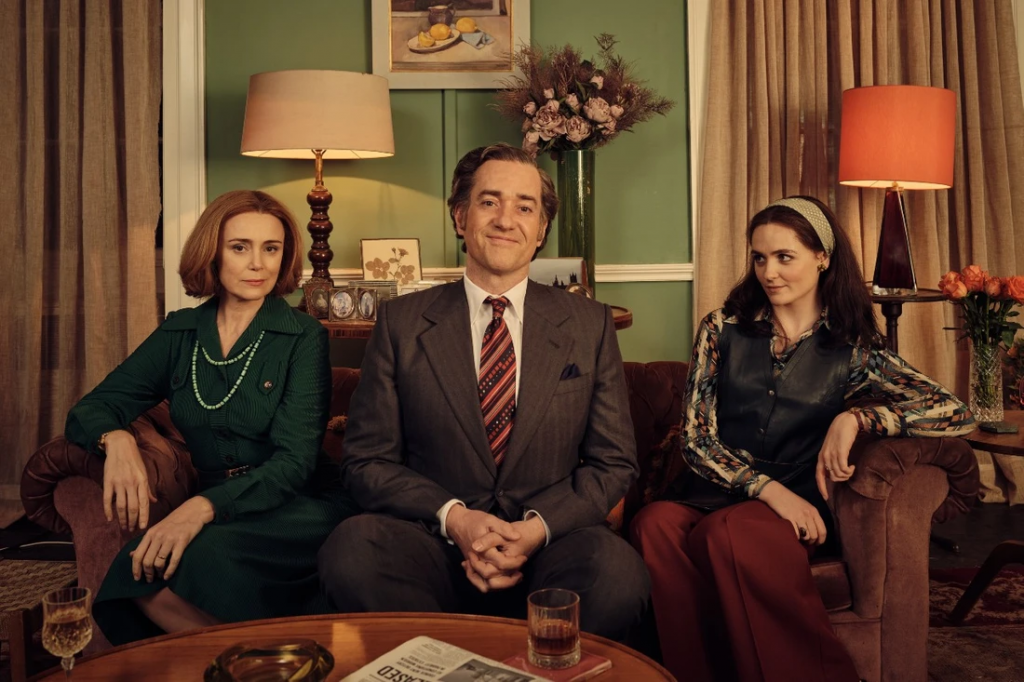
I seem to be handing out five-star ratings like Smarties lately, but I can hardly mark down Matthew Macfadyen and Keeley Hawes just because their new drama is being broadcast during a TV golden patch. I thought Stonehouse, based on a famous true-life story, was a joy, chiefly thanks to Macfadyen’s witty, light on its feet performance as John Stonehouse, the former Labour minister who, after being blackmailed into spying on his country, and sleeping with his secretary, faked his own death Reggie Perrin-style and fled to Australia on a fake passport in the name of a dead constituent. Which makes Matt Hancock flying to Australia to eat sheep’s vagina look tame. I have seen all three episodes and it’s an absolute treat.
Macfadyen, here with a bouffant hairdo, looked as if he’d had to gain a few pounds for the role as Stonehouse waded into the sea in Miami. I wonder if it’s weird having your real wife (Hawes) play your screen wife (Barbara Stonehouse)? And vice versa? Especially when your husband has a naked woman writhing around on top of him to demonstrate the honeytrap in Prague in the late 1960s, when Stonehouse was secretly filmed committing adultery with his translator. If so, neither of them let it show.

Macfadyen’s talent for the comedic, which he executes so brilliantly as oily Tom in Succession, here gets to stretch its legs even more as the buffoonish, handsome, vain Stonehouse, who was tipped as a possible future party leader until his greed and his groin led to his downfall.
The frisky vibe of this series is similar to that of the excellent A Very English Scandal, in which Hugh Grant played Jeremy Thorpe, which is unsurprising since John Preston, its writer, is the author of the book A Very English Scandal. There also feels to be a sprinkle of The Thief, His Wife and the Canoe (about John Darwin, a man who more recently faked his own death), in that it’s a scandal dressed as farce.
Macfadyen’s skill is in making a traitor, a liar and a philanderer almost endearing in his haplessness. Well-spoken Stonehouse is essentially a jovial berk. The scene in which his Czech handler (Igor Grabuzov) told him he was the most useless spy he had encountered, because he kept bringing them news that had already been on TV, or tedious “intel” about first-class stamps, was brilliantly done. Grabuzov’s face, a mix of disgust and pained boredom, was a picture.
Hawes’s role was small during the first episode, but it grows as Stonehouse’s deceit is uncovered. At the moment she is the perfect politician’s wifey, asking no hard questions even when suspicious, and keeping the home fires burning while wearing sensible skirts and blouses. Kevin McNally does a fine impression of Harold Wilson, and Emer Heatley is portraying Stonehouse’s secretary Sheila Buckley as naive but with inner steel. She said her shorthand was a bit “wopey” and that she had a “speech impediment” meaning she can’t pronounce the letter “r”.
If you ask me, Stonehouse is just the lifter we needed in the post-Christmas bloat. We’re only three days into 2023, but already, in Macfadyen and Sarah Lancashire in Happy Valley, we have two strong contenders for performance of the year.
The script is full of good lines and Matthew Macfadyen is a joy to watch
Standard UK
by Melanie McDonagh
So, if you were a minister for aviation on a trip to Czechoslovakia in 1962, right in the middle of the Cold War, and you were taken out to dinner by a bombshell blonde, would or would not the first thing that came into your head be the word: honeytrap?
Well, not if you were John Stonehouse, the ill-fated Labour minister who is now remembered chiefly for his bungled attempt to fake his own death on Miami Beach to start a new life with his mistress Sheila Buckley (played here by Emer Heatley). This imagined but entirely plausible scene is a not-unreasonable assumption about the course of events that led to the unfortunate Stonehouse becoming a Czech spy.
In this richly enjoyable retelling, with Matthew Macfadyen as the minister, we see him the following morning, much the worse for wear, being confronted by a sinister intelligence operative who shows him footage of his encounter with the blonde and tells him this means he must now spy for Czechoslovakia. His first question is, “Will I be paid?”
The real pleasure of this return to the Sixties and early Seventies is watching Matthew Macfadyen as a venal and ambitious narcissist. He’s less handsome than the actual Stonehouse but his face is a shifting register of most of the mortal sins: lust, covetousness, duplicity, greed, ambition and deceit. The wonder is that his put-upon wife, Barbara (Keeley Hawes), puts up with it, but then the two actors are married in real life, which may explain her expert look of resigned stoicism.

John Preston’s script is full of good lines; his last book, on the fall of Robert Maxwell, may have prepared him for Stonehouse. When his wife asks, understandably, where all the money is coming from for a big new house, he asks her patiently, “Darling, which of us is a graduate of the London School of Economics?” Well, that was the Sixties. And when as an election candidate he bounces into a hospital ward, he tells the patients: “You’re all looking terribly well!”
It’s quite possible to sympathise with Macfadyen’s endlessly optimistic, endlessly duplicitous Stonehouse, as he tries to convince himself as much as everyone else, that really, he’s very much put upon, as the net closes in on him. But then it’s also possible to sympathise with his exasperated minder, Alexander Marek (Igor Grabuzov) who declares after yet another dud revelation from Stonehouse, “You are the worst spy EVER”.
Stonehouse is a wonderful subject for a docudrama, an Hogarthian ambitious poor boy (his mother was a scullery maid) who almost rises to the top of British politics, only to be brought low by his own cupidity and rotten judgment. The first episode ends as it begins, with him stepping into the sea off Miami, carefully leaving behind his passport and clothes, emerging to put on a new shirt and identity further down the coast.
And if you want period detail, it’s where Stonehouse, then Postmaster General, enthusiastically explains his plans for a two tier postal system, with a first class post “with a next day delivery in the morning, not the afternoon!” That dates it, doesn’t it?
As a drama, though, the brief rise and astonishing fall of Stonehouse, John Stonehouse, makes for enormously entertaining television
The Guardian
by Rebecca Nicholson
Macfadyen and Keeley Hawes are a cheeky, campy delight in the endlessly entertaining story of the inept MP – and worst spy ever – who disappeared from a Miami beach
Last week, No 10 issued a statement regarding what it considered to be “very concerning” reports of MPs indulging in sex and excessive alcohol while on parliamentary trips abroad. (Perhaps the suitcase full of wine served a purpose beyond Downing Street?) With fortuitous timing, Stonehouse (ITV 1) is here with the vintage edition. This fun and funny drama, high-spirited and revelling in its absurdities, retells the story of John Stonehouse, Labour MP for Walsall North, a former postmaster general and rising star of Harold Wilson’s government, who got himself in a spot of financial and espionage-based bother. His solution was to fake his own death on a beach in Miami in 1974, before fleeing to Australia with his secretary and assuming a new, stolen identity.
The problem for him, and the joy for viewers, is that Stonehouse is not very good at being a baddie. Matthew Macfadyen plays him as a heedless buffoon from the start. In the Commons, he parrots what Wilson says; at home, he parrots what his wife, Barbara (played by Macfadyen’s real-life wife, Keeley Hawes), says. He is a man in search of an identity, and on a work trip to Czechoslovakia (as it was then), he makes much use of the “traditional Czech specialities” on offer by getting extremely drunk and having sex with his guide and translator – an act which is, naturally, filmed by the Czech secret service and used to blackmail him into spying for them.
Stonehouse, a family man in an ordinary house, does not seem particularly perturbed by this development. He sees it as a chance to inject a bit of excitement into his suburban life. The trouble is, he is not very good at spying either. His information is either boring – and the on-screen Stonehouse is talented at boring for England, if nothing else – or delightedly delivers outdated information. “You are the worst spy I have ever come across. Ever!” barks his handler, who wanted state secrets and got a dreary Bond acolyte instead.
He is so bad at delivering useful information that you start to wonder if it is a strategy. One of the case studies in Stephen Grosz’s fascinating book about psychoanalysis, The Examined Life, is of a man who seems set on boring everyone around him; Grosz concludes that it is a deliberate act, designed to exclude others. I wonder if that might be what Stonehouse is up to, but perhaps that is reading too deeply into the story. Besides, the evidence for it turns out not to be particularly strong; Stonehouse gleefully informs the Czechs of the invention of Concorde, only to be told that this bombshell had been on French television news, two nights earlier.
The tone is spot-on, tongue-in-cheek and cheeky. It is written by John Preston, who also wrote the book on which 2018’s A Very English Scandal, about disgraced MP Jeremy Thorpe, was based, and it canters along at a similar pace. Much of the scandalousness is played for comic effect. The title sequence is Mad Men-ish, the soundtrack Pink Panther-esque, and the espionage is campy rather than sinister. Macfadyen’s Stonehouse has a touch of his Succession character, Tom Wambsgans, though the MP lacks the watery cruelness of Wambsgans; Stonehouse is less devious and easier to please.
But there are cruelties here, casually buried within its slapstick, as you might expect from a man who attempts to convince the world he is dead. Poor Barbara tries to intervene in the household budget, as newer cars and bigger houses turn up on the scene while private school fees go unpaid. “Which one of us is a graduate of the London School of Economics?” her husband says, pretending there is nothing to worry about. He hires a secretary whose shorthand is lacking, mostly because he fancies her. And later, he steals the identity of a dead constituent, flattering his widow by attending the man’s funeral, only to betray him for his own dreadful purposes.
Last July, Stonehouse’s daughter expressed concerns that the drama would be a “misrepresentation” of her father’s story. As with most of these types of drama, it gets a disclaimer at the beginning, explaining that it is “based on a true story” with some parts “reimagined” for dramatic purposes. It seems inevitable that there would be complaints by surviving relatives, as it is not particularly sympathetic to Stonehouse. From The Crown to The Thief, His Wife and the Canoe, the question of what a drama inspired by real life owes to its subjects, if it owes anything at all, will continue to be the subject of debate. As a drama, though, the brief rise and astonishing fall of Stonehouse, John Stonehouse, makes for enormously entertaining television.
Stonehouse brings the feverish furores of the 1970s back to life
The Independent
by Nick Hilton
Jon S Baird’s miniseries opens in 1960s Westminster, where John Stonehouse (Matthew Macfadyen) is an up-and-comer in the Labour Party. “What do we know about him?” asks prime minister Harold Wilson (Kevin R McNally playing Wilson for the second time, perfectly, having portrayed him in the 2015 film Legend). “Working-class boy. Parents both trade unionists. Served in the RAF during the war.” Naturally, he’s made aviation minister – a role that takes him to Prague and into the arms of an obvious honey trap. “We would like you to become an unofficial representative of our country in Great Britain,” he’s told, in a smoke-filled Soviet interrogation room, as the film of his tryst is slid across the table. And so begins the decade-long unravelling of his life, a process that will end with him leaving his folded clothes and passport on a Florida beach and swimming out to sea.
Macfadyen is one of Britain’s finest actors, and his performance as Stonehouse rounds out a trilogy of depictions of men hanging by a thread. Beleaguered Tom Wambsgans in Succession, shifty Major Charles Ingram in Quiz, and now, the hammiest of the roles, the unprincipled former MP for Wednesbury. Macfadyen plays Stonehouse – who would assume the identity of a dead constituent after his disappearance – as a man already living out a synthetic version of life. If you can judge a person’s happiness from the sincerity of their laugh, then Stonehouse is in deep despair. “I don’t think he’s a wise man,” a foreign businessman tells the audience, via subtitles. “Haha,” chuckles Stonehouse in response. “Terrific!”
If the role feels more cartoonish than his undertakings in Succession or Quiz, then the issue is probably that the script isn’t written by Jesse Armstrong or James Graham. Writing duties are handed to John Preston (a fine writer; author of non-fiction books like A Very English Scandal, about Jeremy Thorpe, and Fall, the story of Robert Maxwell) for his first screenplay. The final product is, stylistically, a farce. “The important thing about being a spy,” Stonehouse is told by his Czech handler Marek (Igor Grabuzov), “is that you have to get information before everyone else, not after!” This sense that we are in a light-hearted caper is abetted by a score crammed with suspicious woodwinds and bouncy snare drums. The result is something that feels no deeper than the azure Miami waters into which Stonehouse wades.
But Macfadyen is always enjoyable to watch, even if his showy take distracts from the more subtle performance of Keeley Hawes (Macfadyen’s real-life wife) as Mrs Stonehouse. And the story of Stonehouse is itself a pleasantly victimless one. Sure, the kids might get pulled out of private school, the manor house sold, but as political scandals go, this is less sinister and more ludicrous. “It’s Stonehouse,” he announces over the intercom at the Czech embassy. “John Stonehouse.” Brash and buffoonish, he is more Austin Powers than James Bond – and that’s no bad thing.
Sandwiched between the Profumo affair in 1963 and the Thorpe scandal in the late 1970s, the Stonehouse saga is perhaps not quite as memorable. It is slighter and sillier, but still jaw-dropping in its audacity. Anchored by Macfadyen’s nimble turn at physical comedy, Stonehouse once again brings the feverish furores of the 1970s back to life.
John Stonehouse: Labour MP, husband to Barbara, Czechoslovak double agent, father of two, failed businessman, missing person. Stonehouse, the story of a sitting MP who faked his own death – dramatised this new year over three hour-long episodes on ITV – is a remarkable tale. But for all the twists and turns of the Stonehouse legend, the most unbelievable thing in all of this is the fact that it’s taken almost half a century to be brought to our screens.
It is a comedy masterclass
The Telegraph