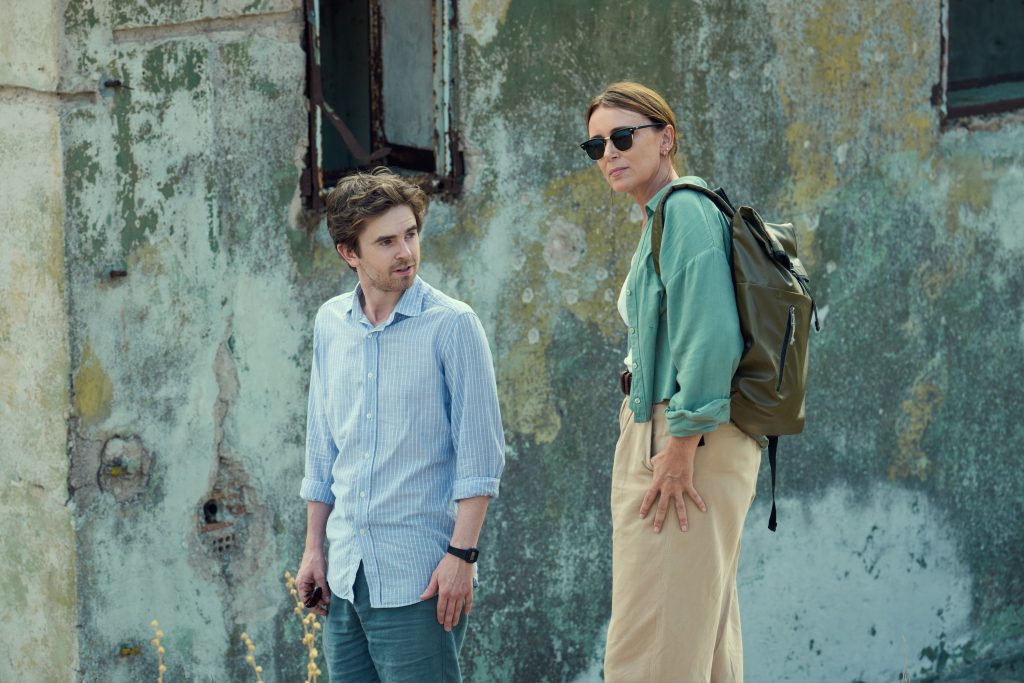
The Assassin, coming to Universal+, gave stars Keeley Hawes and Freddie Highmore the chance to explore a complex mother-son relationship, dive deep into their characters, and enjoy the stunning Greek locations—plus a rare opportunity to collaborate as executive producers
Written by Caio Coletti
The Assassin lives and dies by the chemistry between Freddie Highmore and Keeley Hawes, playing mother (a retired hitwoman) and son (a journalist determined to uncover her secret) as they get caught up in a complex conspiracy that forces them to flee across the stunning landscapes of Greece. The blend of comedy, action, and family drama, led by showrunners Harry and Jack Williams (The Missing), only truly works because the former child star of Charlie and the Chocolate Factory and the venerable British actress of Bodyguard perform a delicate dance of resentment, affection, and secrets with each other.
Omelete had the chance to attend a press conference with the duo – below, you can read the conversation, which touched on motherhood, television vs. cinema, the actors’ creative involvement in the production, and much more. The six-episode miniseries The Assassin arrives next Tuesday (26th) on Universal+.
Q: Freddie, combining your work on Bates Motel, The Good Doctor, and now The Assassin, you’ve been on TV for 13 uninterrupted seasons. So, what is it about television that draws you in so much? Is it a matter of the roles being better, or having more time to explore the character?
HIGHMORE: I think, before any of that, it’s just about luck. You know, it’s only three projects, so I was lucky to find them quickly and see them last for a while. But I love TV—and even in a six-episode miniseries like The Assassin, I love how television gives me the chance to really dive into the characters, more than you can in 90 minutes of a movie. I can’t imagine The Assassin, for example, as a film, given the complex nature of this mother-and-son relationship. Even at the end of the six episodes, I hope people think, “Ah, there’s still a little more I want to discover about this duo.”
So yes, I think I was lucky, but I also really enjoy the depths you can explore with characters on television.
Q: Freddie, you mentioned this complex mother-and-son relationship that forms the foundation of The Assassin. My question is for both of you: what was it like building this relationship on set? And how would you describe it exactly?
HAWES: I feel like we were incredibly lucky. From the start, when we first met over Zoom, we had a lovely conversation, and then a full day of rehearsal reading the script. For me, it became clear very quickly that we wouldn’t have to work hard to build this relationship, because it felt like we’d known each other for ages. It was a bit strange, actually [laughs]. It was just a joy to work with Freddie—I feel like I’ve known him much longer than I actually have. We work in very similar ways as actors, so there wasn’t really anything to resolve, and I felt incredibly lucky from day one because we could just get on with filming. I think we created a lovely bond, great chemistry, and we became good friends.
HIGHMORE: Yes, I feel the tone of the series is so specific, and I think it was amazing to meet Keeley for the first time and realize that we both, instinctively, felt that tone in exactly the same way. In this series, the underlying humor is always there—there are some dark jokes—but it’s not overdone and doesn’t take away from the bigger emotions, the high stakes, and the twists—it’s there to add nuance and texture. When it comes to these characters, you need to like them as a duo, even if they’re at odds in the story, or somewhat distant and keeping secrets from each other. We both wanted them to be a captivating pair, people you’d enjoy spending time watching. Otherwise, it would just be a series about two people constantly arguing, and that can be really boring.
Q: Well, besides starring in the series, you both are also executive producers. What did you learn about each other through this collaboration? And what were the main decisions you made together, on both sides of the process?
HAWES: You know, every series is different. In some, you come in early and help shape the characters and the story in that producer capacity; in others, you join when the scripts already exist and the season is already underway—as we did in this case. But I think we came in at an interesting moment, when the major decisions had already been made, yet we could move forward with the project, oversee post-production, and give notes on episode edits, for example. It was at a lovely point, when there was already a commission and many of the key decisions were set. Freddie is so brilliant and has more experience in this area than I do; I’ve been an executive producer on a few series, co-produced a few, but he has much more experience in this field. So for me, it was wonderful to see him in that role. And honestly, having actors in a producer role can be very, very useful.
HIGHMORE: Yes, it was really fun watching the editing process with Keeley. When you have showrunners like Jack and Harry Williams running the show, of course your role is to support them and their vision, helping to make the series they imagined in the best possible way. But sometimes it’s also nice to have a shoot like ours, which was in Greece, far from the writers’ room—you get the freedom to say, “Ah, we tried this on set that day, I think it worked pretty well, take a look.” Especially because getting the tone right between our two characters and performances was so important, I think we were able to contribute a lot during editing. We knew exactly what we were aiming for.
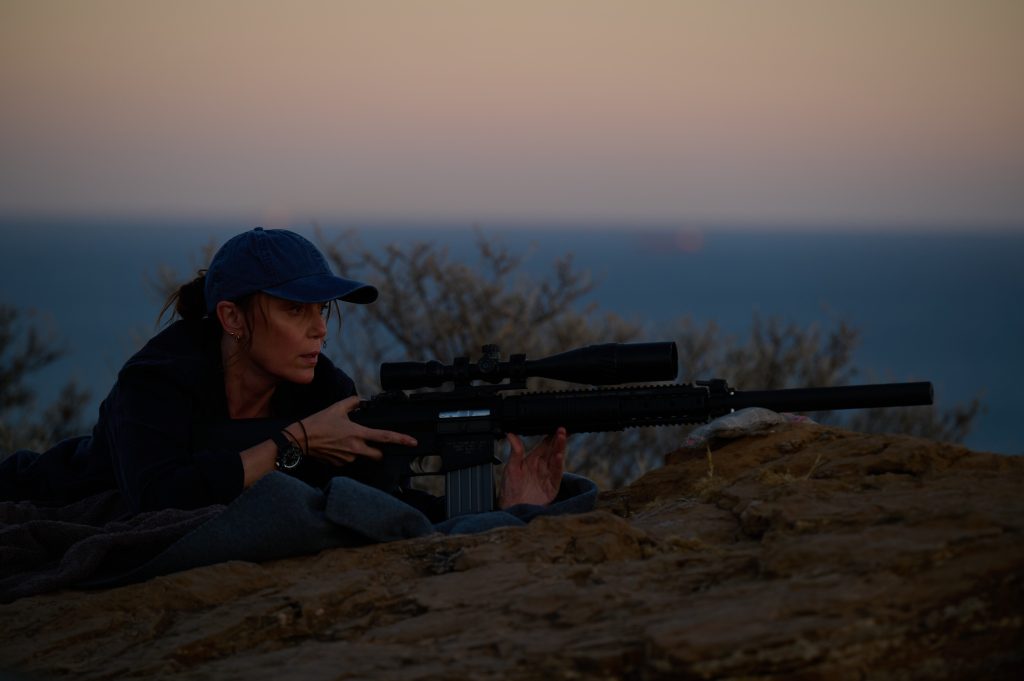
Q: Keeley, in the first episode, Julie says to Edward, “I’m your mother, and that’s why I’m not going to tell you whatever it is you think you need to know.” I loved that line!
HAWES: I love that line too! I’ve actually used it a few times in real life.
Q: When you first read the script for The Assassin, what did you feel the series had to say about motherhood? Was that theme part of what drew you in?
HAWES: Yes, it really was. Julie is kind of the anti-mother, isn’t she? The only other time I worked in Greece was on a series called The Durrells, playing a very different kind of mother. Louisa Durrell was a truly devoted and brilliant mother, but Julie is a bit the opposite. She isn’t a natural mother, and I think it’s a much harder job for her. What’s not in question is how much she loves Edward—but she isn’t maternal by nature. And, of course, that’s incredibly fun to play.
I think Julie probably always treated her son as an adult, and that’s how their relationship has been. So when she talks to him, it comes across as very abrupt and sharp, and she has this unexpected honesty about things. I think it can be quite shocking, but, you know, I have three children, and I can tell you being a mother isn’t always sweetness and light. Sometimes, with your kids—and they with you!—you can be more honest, more yourself than with anyone else in the world. So yes, I feel that is portrayed very truthfully in The Assassin’s script.
HIGHMORE: I just want to say I also love that moment in the episode. Actually, when I watched the series for the first time, I was with other people—and in that scene, they applauded loudly. It was like, “Yes! Put him in his place!”
Q: Keeley, you talked about the script. How would you describe Harry and Jack’s work, and the humor they bring to their stories—even the ones that don’t seem like natural comedies?
HAWES: I’m always impressed that they are the same people who created The Missing. Their series are so eclectic in tone, and they have an enormous range. On the other hand, as people, they’re so collaborative and relaxed, respectful with the actors—they really trust us with the characters they’ve created. For me, that’s the best possible scenario, because you feel comfortable with the script and the scenes, and that you can really make the character your own, which is very important. You know, you’re performing the role… once it’s written and delivered to you, it should, in a way, become yours. But that’s not always the case; it’s not how some writers work.
HIGHMORE: I agree with everything Keeley said about them. I think what they do excellently, too, is create propulsive plots, with lots of twists and cliffhangers—but none of it feels like it’s there just for the sake of it, or just to advance the story. Everything they do is rooted in the characters, in true, realistic, and honest decisions those characters make. And I think, unlike some thrillers, this series always feels quite grounded, very real. Our characters aren’t superheroes—they make mistakes, and they make a lot of them! They make errors in their relationships with each other, mistakes in how they handle danger, mistakes in keeping secrets they shouldn’t have… they just keep getting deeper into all these mistakes. I think there’s something relatable in that for the audience.
Q: As you mentioned, this series was filmed in Greece. What kind of challenges did you face there? Did the location change the way you connected with the story, or even with the characters?
HAWES: We spent five months in Athens, which doubled for all the locations, and above all, it was simply delightful. I hadn’t been to Athens for a long time, so I was very excited to return. And, you know, when you’re in a place for so long, you get to explore it and see it in a way you normally wouldn’t. We were lucky to go to locations that, even if you visit Greece, you often wouldn’t see as a tourist. So it was just wonderful to be there. In the series, I think the island is almost a character itself, and it has a huge influence on the look of all the scenes. I think The Assassin is a very stylish series, and much of that is thanks to the incredible locations.
HIGHMORE: I’d say the moments we felt most isolated were the scenes on boats. We have a yacht right at the beginning of the series, and later there’s another boat… On those days, we’d go out to sea with a very, very small crew—the bare minimum—and we’d wave to the rest of the crew on the beach. We’d be working all day! [Laughs] But I always love those moments when everything feels more intimate, smaller… it’s such a lovely memory.
The Assassin streams on Universal+ beginning August 26.
Source: Omelete