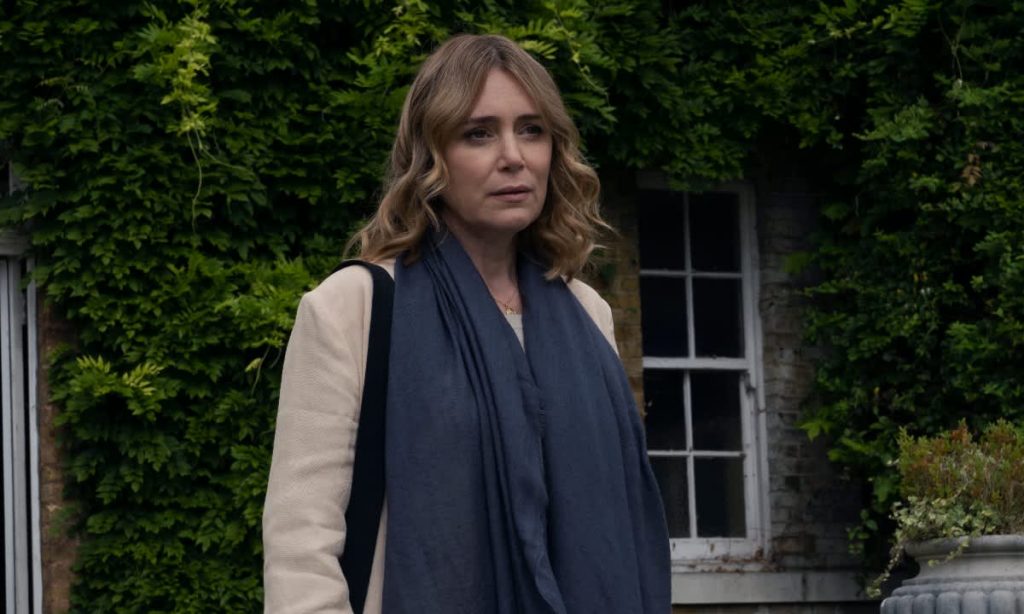
Keeley Hawes is happy to ignore the old line about not working with children – even if they’re the stuff of nightmares.
She’s worked with young talent in The Durrells and It’s a Sin, so it feels safe to assume that Keeley Hawes enjoys taking risks when acting. “They are my favourite thing,” she says. “Children and animals, actually. You never quite know what you’re going to get, and that is really exciting in a take, or on a filming day in general. I love it.” Her latest TV drama reflects this enthusiasm. It’s a blustery autumn afternoon in rural Oxfordshire, and school’s out: two pre-teens, given to dressing identically in blazers and with preternaturally perfect and oddly adult teeth, have been taken for “advance testing” of their intelligence.
“They’re so special,” says psychotherapist Dr Susannah Zellaby (Hawes), to DCI Paul Haynes (Max Beesley), as the pair sit in a Land Rover waiting for their young charges. “Something’s wrong,” says Haynes, “mobile reception’s gone.” Suddenly, Haynes and Zellaby are gone, too – the actors slump unconscious. It’s day 95 of the 104-day shoot for The Midwich Cuckoos, Sky’s modern-day adaptation of John Wyndham’s 1957 novel. This classic of 20th-century British science fiction, subsequently filmed in 1960 as Village of the Damned, has been adapted and modernised by David Farr, who also adapted John le Carre’s The Night Manager for TV. It’s the story of an ordinary town (“somewhere vaguely Aylesbury-ish,” says Farr) that suffers a 12-hour forcefield-cumblackout. No one can get in, and everyone inside falls unconscious. After normal service is seemingly resumed, every woman of child-bearing age discovers that she’s pregnant, regardless of her sexual activity, or lack thereof. Seven (yes, seven) months later, all give birth at exactly the same time. The cacophony of synchronised labour pains in episode two, brilliantly shot by lead director Alice Troughton (A Discovery of Witches), is only the start of the terror.
The Midwich Cuckoos is a supernatural tale of children of unknown parentage and with unknowable intention, linked by a “hive-mind” intelligence. But whereas the novel and film foregrounded Wyndham’s Cold War-era, fearof-Communism allegory, Farr’s adaptation is more nuanced.
“It’s about our loss of confidence in our civilized world, how we are perhaps the most anxious we have ever been,” says the screenwriter. “The obvious reason for that is environmental. In the younger generation, particularly, there’s a feeling that we’re potentially coming to an end.” And on another level, in the words of Troughton, it’s “female gaze horror”. “God, she’s great, Alice!” exclaims Hawes when I relay her director’s comment. “That is a perfect description of what this is. The show is about these women having their bodies overtaken by something. And the idea of having something inside you is already very odd!” she adds, laughing over Zoom – six months after my set visit – from a study in the London home she shares with husband Matthew Macfadyen.
“I’ve been pregnant three times – it is really quite weird, let alone not knowing what it is inside you. Each of these women have their own dilemma: they want it so desperately, or they don’t want it desperately. It’s actually very moving. So it’s horror, but it’s also very human and emotional.” Hawes is quick to credit the young cast, a classroom-sized cohort of children drawn from some 2,000 audition tapes. The child actors are all aged around 11, playing children who are actually only five in earth terms but whose otherworldly intelligence means they develop rapidly.
“The kids are phenomenal! We [adults] were like, you don’t need us in this show, because you’ve got these kids who people won’t be able to take their eyes off.” That especially goes for 12-year-old Indica Watson, who plays Dr Zellaby’s granddaughter Evie. “Actually, this is a real sign of the times but I’ve played Indica’s grandmother before – in my 30s!” Hawes hoots, referring to the second series of the 2016 drama The Missing. Do these young actors seek the advice of someone, now 46, who has herself been acting since she was 13 and appearing in prestige dramas, from Our Mutual Friend t o Bodyguard via Spooks, for over two decades? “They do, actually. And that makes you feel very old. We just did Stonehouse, which is really good fun,” she says, of the in-theworks ITV drama about the disgraced 1970s MP John Stonehouse, with Macfadyen in the title role and Hawes playing his wife Barbara. “We had these two lovely young actresses playing our daughters, and we’d sit and talk about auditions and learning lines. At this point, about a hundred years in, you have experienced all of those things.”
Is there a Keeley Hawes Standard Top Tip for would-be grown-up actors? “Get out while you can!” she shoots back, laughing uproariously. “No, it’s not! One of our children is interested in acting, and people often ask whether we’d encourage or discourage them. I’d absolutely encourage them. There aren’t many jobs like the ones that we’re lucky enough to do.
But it’s important to not always be looking to the next one, and therefore not enjoying the moment you’re in. That’s just quite a good lesson for life, isn’t it?” Equally, as an executive producer – as she is on upcoming BBC miniseries Crossfire, about a terrorist attack on a holiday resort, in which she also stars – Hawes is intent on making sure TV production crews have fair representation. On The Midwich Cuckoos, which features three female writers alongside Farr, plus two female directors, that was paramount. “But that’s important now in every show, regardless of what it’s about,” notes Hawes. “It’s something that is changing.
Ten years ago if, say, you wanted a female director of photography, there was one, called Cinders,” she says of Cinders Forshaw, with whom she worked on Tipping the Velvet (1998). “And you couldn’t get her because she was always busy, because she was brilliant! “Now there are options, and you can see those differences when you’re crewing up for a show: there are women there. And it just makes a difference. Having a mixture of male and female energy on set, and anywhere, is a good thing – particularly for this show. But it’s important across the board.”